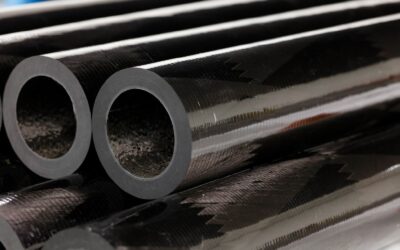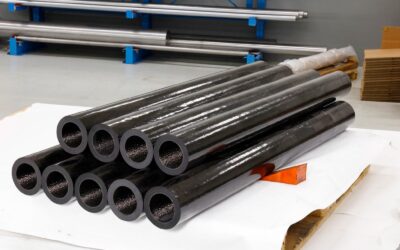


Carbon fiber rollers represent an advanced engineering solution for industrial applications requiring high stiffness, low weight, excellent rotational accuracy and superior dynamic performance.
Thanks to the outstanding mechanical properties of composite materials, carbon fiber rollers are widely used in industries such as flexographic printing, converting, paper, tissue, plastic film processing, nonwoven production and many other high-performance manufacturing applications.
Compared with traditional steel or aluminum rollers, composite rollers provide a significantly higher stiffness-to-weight ratio. This allows lower rotational inertia, higher critical speeds and reduced deflection under load. The result is improved dynamic stability, lower vibration levels, greater rotational accuracy and enhanced process quality, even at very high operating speeds.
Every Fibercompositi roller is designed and manufactured entirely in-house to provide the optimum solution for each customer's application. Our engineering team develops every roller based on the actual operating conditions, including geometry, applied loads, rotational speed, environmental conditions and required performance.
Production is carried out using Filament Winding technology, allowing precise control of fiber orientation while ensuring excellent manufacturing consistency and repeatability. Through dedicated structural analysis and optimized carbon fiber lay-up, the laminate is engineered to achieve the best balance between stiffness, lightweight construction, dynamic behavior and long service life.
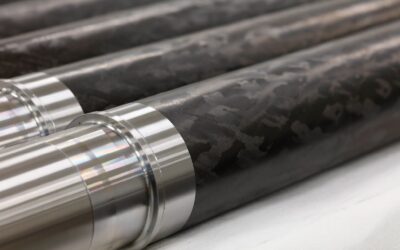
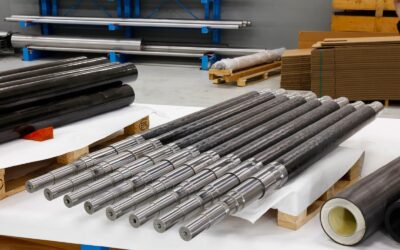
The manufacturing process is completed with precision machining, assembly of metallic journals, dimensional inspections, quality control and, whenever required, dynamic balancing.
Fibercompositi manufactures custom carbon fiber rollers with diameters up to 300 mm and lengths up to 6.5 metres, providing tailor-made solutions for OEMs and end users worldwide.
Extremely lightweight compared to steel and aluminum
Low rotational inertia
Higher rotation speed and increased productivity
High rigidity with less deflection
Ease of handling, resulting in simplified maintenance
Improved product qualityLower energy consumption
Lower energy consumption